Your New AI Coworker: What Claude Duet Means for Your Job
Watch on YouTube: https://youtu.be/BsWBqBsu2vU
Also listed under Blog (same video, different shelf).
Key takeaways
- Claude Duet (Anthropic, 21 Oct 2026): a "proactive agent" app for iPhone, Android and the web. Morning brief, checks your connected apps every few hours, works on its own cloud computer
- Connects to 6,000+ apps and plugins (e.g. Gmail, Slack, QuickBooks, HubSpot)
- Asks for your approval before it sends, pays, signs or deletes. Some actions, like trading securities, are off limits
- Research preview with a waitlist, US Pro and Max subscribers only. Team and Enterprise plans are not included yet
- Anthropic's own caveats: it may misread a thread or misjudge what's urgent, and background checks count against your plan's usage limits
- Google Docs Live (same day): speak your ideas and Gemini turns them into a structured first draft, using context from Gmail, Chat and Drive
- Gallup (Q2 2026, May 6-20): 52% of US employees use AI at work, 30% a few times a week or more, 15% daily
- Harvard/BCG experiment (2023, 758 consultants): 12% more tasks and 25% faster on tasks AI was good at. On a task just outside its abilities, correct answers fell from about 85% to about 71% with AI
Chapters
- 0:00 AI coworkers are here
- 0:36 What Claude Duet actually is
- 2:07 Not just Anthropic
- 3:06 What changes in your day
- 4:11 The honest limits
- 5:15 Skills to build
- 6:46 The takeaway
FAQ
What is Claude Duet?
Per Anthropic’s 21 October announcement, Claude Duet is a separate proactive agent app (iPhone, Android, web). It can send a morning brief, watch connected work context, and surface items that need attention instead of waiting for every prompt.
How is an AI coworker different from a chatbot?
A chatbot waits for questions. An AI coworker is designed to monitor threads, calendars and docs and come to you with drafts or alerts—more like a junior colleague who prepares work for your review.
What is Google Docs Live?
Google began rolling Docs Live to Workspace users in the Docs mobile app: you talk through messy ideas and Gemini drafts a structured document using context from email, chat and Drive (for updates, proposals, meeting notes).
What skills matter when you have an AI coworker?
Delegation (clear goals and “done”), checking (catch wrong numbers/names/tone), prioritising (decide what actually matters), and accountability (you own the send button).
Sources
- Anthropic, Introducing Claude Duet (21 Oct 2026):
- Google Workspace Updates, Docs Live in Google Docs on mobile:
- Reuters, Anthropic unveils Claude Duet AI agent app (via Investing.com):
- Gallup, Organizational AI Adoption Jumps Six Points (July 2026):
- Dell'Acqua et al., Navigating the Jagged Technological Frontier (Harvard Business School / BCG, 2023):
Want more like this?
Calm, sourced videos on AI and work — no doom scroll.
Related videos
 8:53
The AI Skills Employers Want Now (Beyond Prompting)
Is "learn to prompt" still the AI skill to have? New hiring data says companies are already moving on. Workday's October 2026 Global Workforce Report found demand for basic AI skills like simple prompting peaked in January 2026 and then fell 25%, while hands-on skills like automating workflows rose 51%. In Part 3 of our series, we explain what that means for normal office workers, show a no-code example of automating a weekly report, and give you 5 steps to start this week.
 9:18
Will AI Replace My Job? What the 2026 Data Actually Says
Will AI replace your job? Probably not the way the headlines say. In this video we go through the latest research from BCG, the World Economic Forum, McKinsey, Stanford, and Anthropic. You'll learn what AI is actually doing to jobs in 2026, which tasks are at risk, who is really getting hit (hint: entry-level hiring), and what you can do about it starting this week. No hype. No doom. Just what AI really means for your work.
 8:35
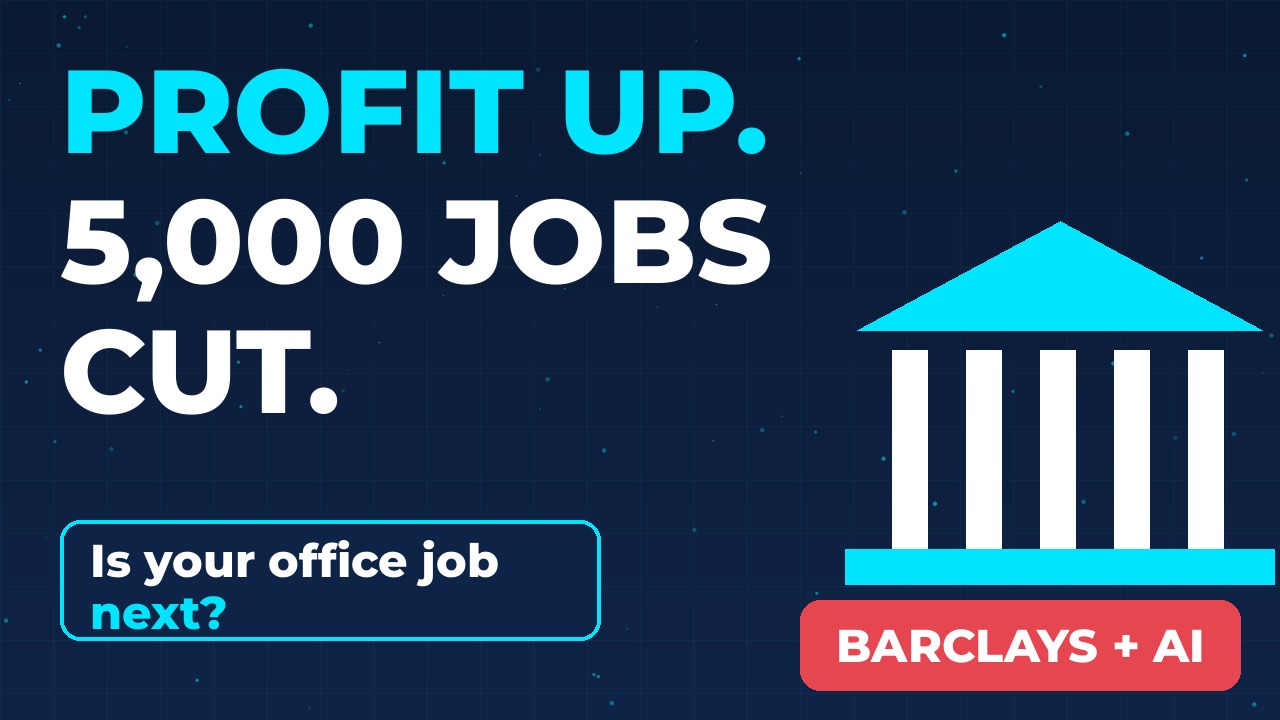
AI Layoffs 2026: What Barclays’ Job Cuts Mean for Office Work
Barclays is cutting around 5,000 jobs, and on the same day it reported a 12% rise in quarterly pre-tax profit. The bank says AI is part of the reason, but not the whole story. In this video: what Barclays actually announced, who else is cutting jobs and citing AI (Kroger, FICO, DNB, HSBC, Standard Chartered), how much of this is really about AI, why "support functions" are most exposed, and a simple 3-question test for your own job.